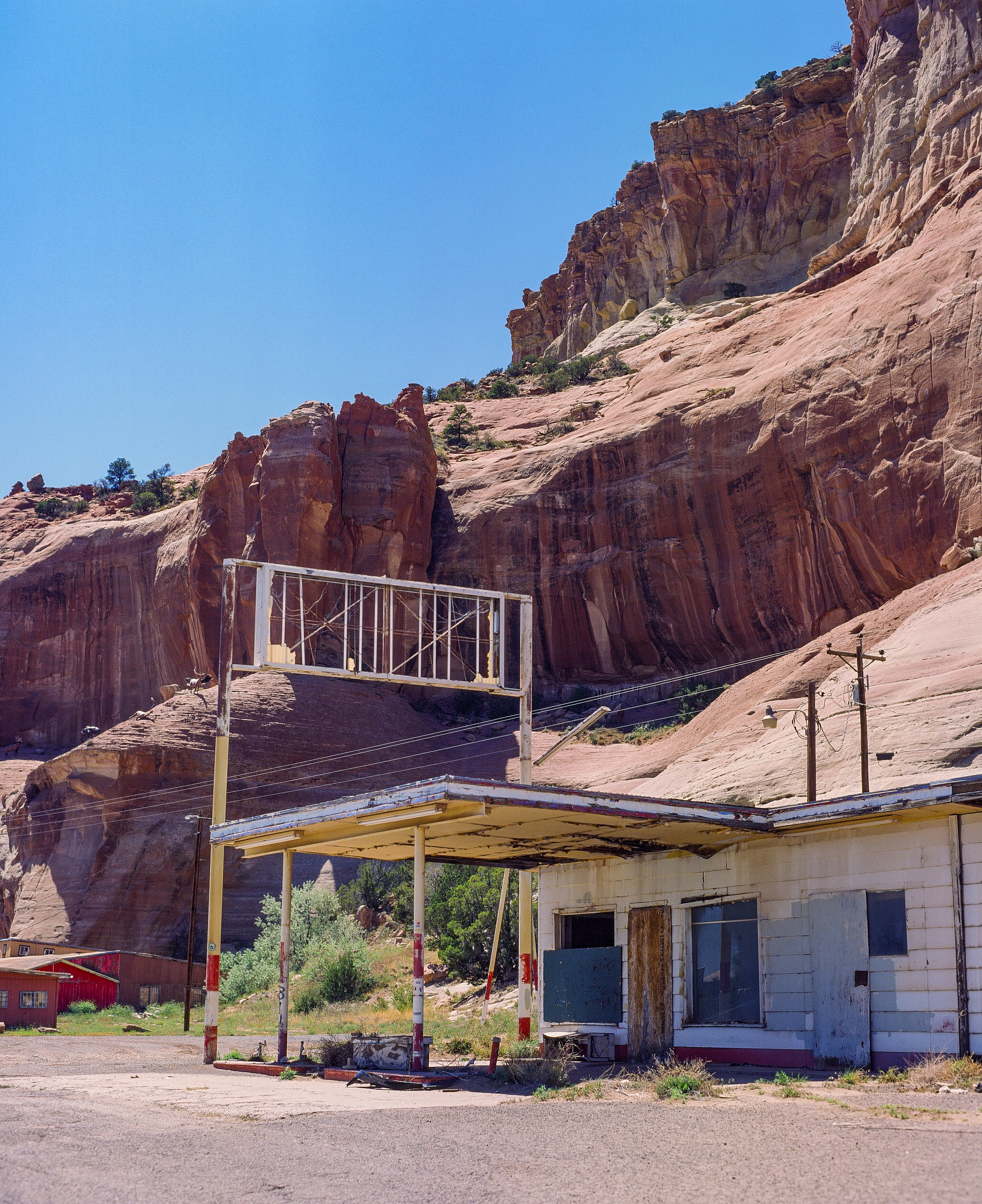
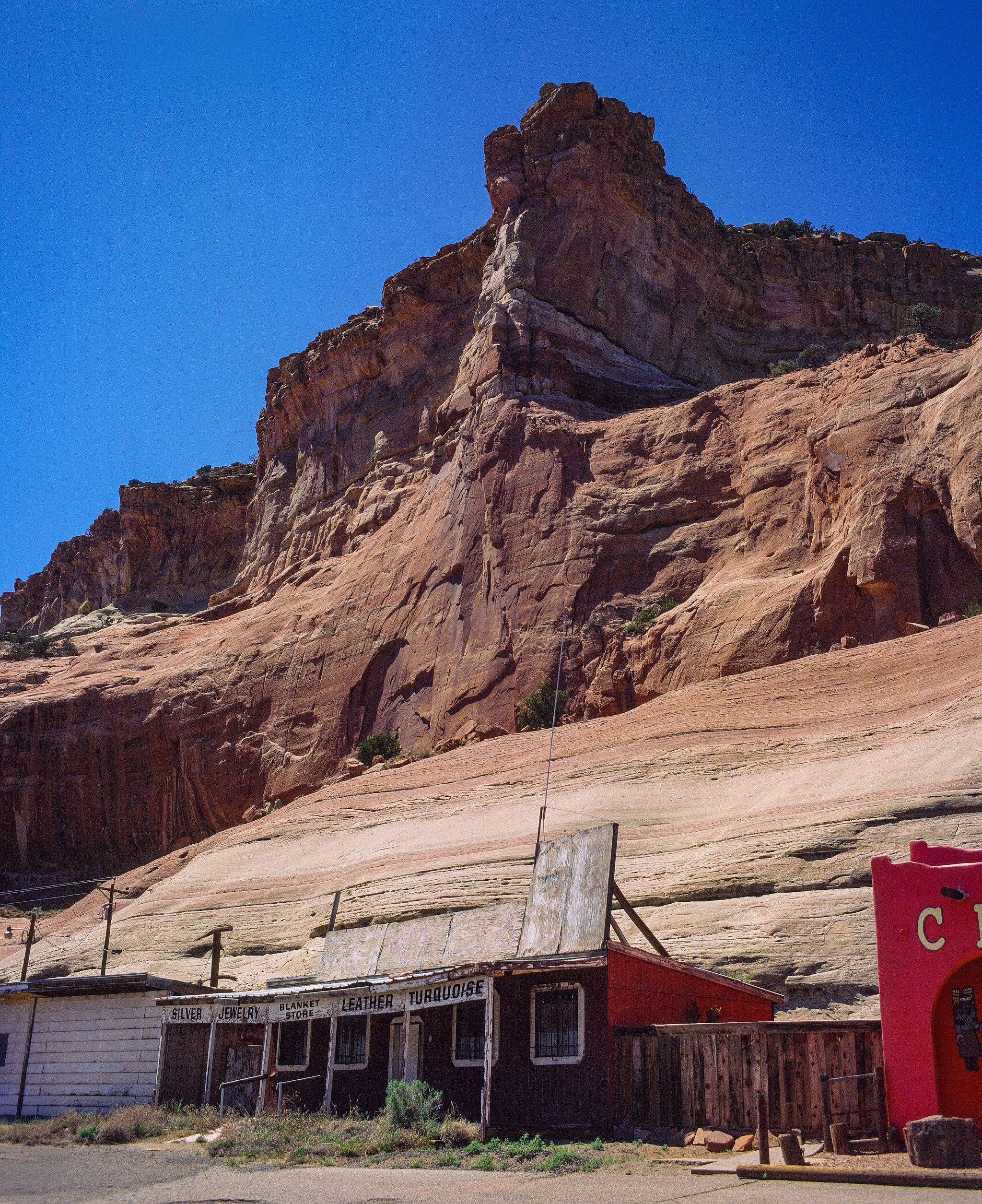
This scene caught my attention near the base of Cecilia Cavazos Red Rock Monument. An abandoned gas station sits quietly beneath towering sandstone cliffs, a scene that feels frozen in time along this stretch of the American Southwest.
What initially looked like a forgotten building became a study in scale—the weathered structure nearly disappearing against the massive red rock formations rising behind it. These are the kinds of places that make a cross-country road trip memorable: locations with no destination, no crowds, and no signs directing you to stop.
Photographed on a Pentax 67 with a 75mm f/4.5 lens using Kodak Ektachrome E100 film. The combination of medium format film and E100’s vibrant color palette rendered the deep blue sky and warm sandstone tones exactly as they appeared on that clear desert afternoon near the Arizona–New Mexico border.
A forgotten roadside stop near the Arizona and New Mexico state line became one of the most memorable scenes from our cross-country drive from Nashville to Seattle. The abandoned storefront sits beneath towering sandstone cliffs, a reminder of the quiet places that often go unnoticed when traveling the American Southwest. Photographed on a Pentax 67 with a 75mm f/4.5 lens using Kodak Ektachrome E100 slide film, capturing the rich reds of the desert landscape and the deep blue desert sky.
Two images pulled from the archives that highlight a cold night in Lethbridge as the snow started to fall. A plow truck tailing behind the car I’m shooting from, and snowflakes falling on the parking lot at the UofL. The light posts used to match the architecture of the university. A detail that was not worth preserving over the years of renovations on campus.
As an architectural photographer, I’m always drawn to the relationship between light, structure, and place. My goal with this image was to photograph the full moon rising over the Nashville skyline, but what makes the scene special is the balance of three elements occurring at once. Behind the camera, the setting sun cast warm light onto the downtown buildings, illuminating their glass facades just as the full moon appeared above the city. For a few brief moments, the skyline sat perfectly between sunset and moonrise, connecting the end of one day with the beginning of the night. Capturing the photograph required careful planning, timing, and positioning, but the result reflects exactly what drew me to the scene: the intersection of architecture, natural light, and the rhythms of the landscape surrounding the city.
Figure walking a dog perfectly framed between the columns of the Parthenon in Nashville, Tennessee, illustrating the scale and symmetry of the landmark’s classical architecture.
As an architectural photographer, I’m constantly looking for viewpoints that reveal the relationship between a city and its surrounding landscape. This photograph was made from the John Seigenthaler Pedestrian Bridge overlooking the Cumberland River, one of the best locations to appreciate the scale and character of the Nashville skyline. From this vantage point, the river acts as a natural foreground, separating the city’s modern architecture from the viewer while creating a sense of depth that defines the downtown skyline.
The image was photographed using a Widelux panoramic film camera, a unique swing-lens camera that exposes a panoramic negative by rotating the lens during the exposure. Unlike a conventional 35mm camera, the Widelux captures an exceptionally wide field of view, making it particularly well suited for architectural and urban landscapes. The panoramic format allowed me to include both downtown Nashville and Nissan Stadium across the Cumberland River in a single frame, creating a perspective that more closely resembles the experience of standing on the bridge and taking in the city.
One of the qualities I appreciate most about the Widelux is the way it renders space. The camera’s swing-lens design introduces subtle distortion near the edges of the frame, stretching perspective and emphasizing the breadth of the scene. In a cityscape like Nashville, that distortion becomes part of the visual language of the photograph, reinforcing the scale of the skyline and the sweeping curve of the river below.
Photographed from the John Seigenthaler Pedestrian Bridge, this image captures a moment where architecture, infrastructure, and landscape converge. The Cumberland River, the downtown Nashville skyline, and the city’s evolving collection of buildings all come together within a single panoramic frame—a view that the Widelux was uniquely designed to capture.
A limitation of the Widelux camera is its inability to manage light flare effectively. By positioning the sun behind the bridge in this photograph, I was able to work around this issue while still capturing both the bridge and downtown Nashville.
Lower Broadway is one of Nashville’s most recognizable streets, where historic architecture, live music, and constant activity come together in a uniquely urban setting. I photographed this evening scene using a Pentax ME Super 35mm film camera loaded with Rollei RPX 400 film. The combination of black-and-white film and the fading evening light helped preserve the atmosphere of the street, from the illuminated storefronts to the historic building facades that define Broadway’s character.
Rollei RPX 400 handled the challenging lighting conditions well, retaining detail in both the bright signs and the darker shadows of the street. As an architectural photographer, I’m often drawn to how buildings shape the identity of a city, and Lower Broadway’s collection of historic commercial structures remains one of Nashville’s most iconic urban landscapes. This photograph captures a brief moment when the architecture, light, and activity of downtown Nashville all came together within a single frame.