Archive for the ‘Nashville’ tag
Printers Alley at Night | Pentax 67 and CineStill 800T Film
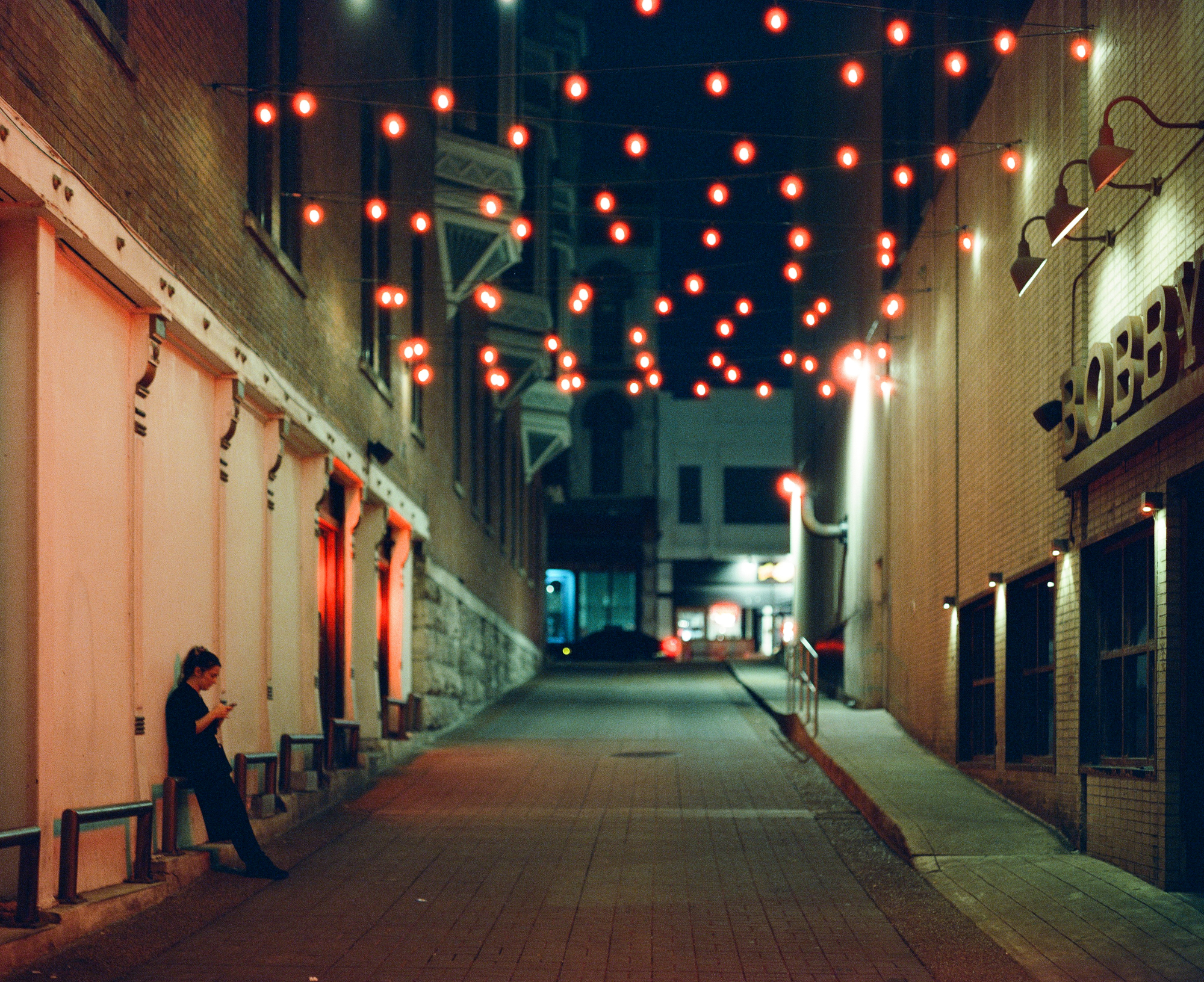
One evening I set out to explore Nashville’s Printers Alley with my Pentax 67, curious to see how well I could handhold medium format film after dark. Loaded with CineStill 800T, the goal was simple: capture the atmosphere of the alley’s neon lights without the aid of a tripod. The Pentax 67 is a heavy camera, so every frame required bracing against a wall or pulling the camera tightly into my shoulder to keep it as steady as possible while shooting.
CineStill 800T proved to be the perfect film stock for the evening. Its signature halation effect glows around the hanging lights that stretch across Printers Alley, adding a cinematic quality to each frame.
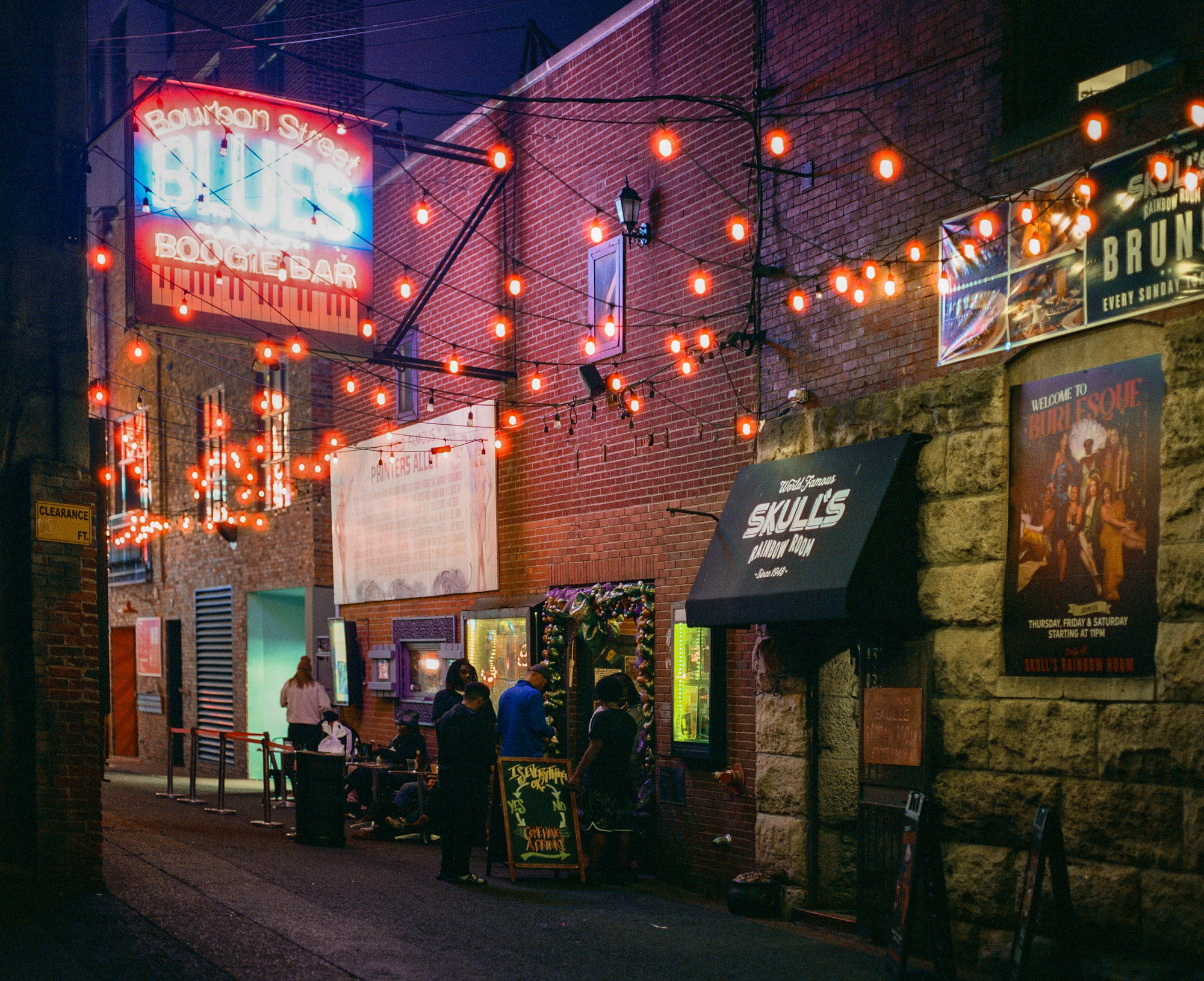
The first image captures the iconic Bourbon Street Blues and Boogie Bar illuminated beneath the alley lights, while the second turns the camera toward a quieter moment—a lone employee taking a smoke break just around the corner. Together, the photographs showcase why CineStill 800T has become one of my favorite film stocks for night photography.
Nashville Skyline and Cumberland River on a Widelux Film Camera

As an architectural photographer, I’m constantly looking for viewpoints that reveal the relationship between a city and its surrounding landscape. This photograph was made from the John Seigenthaler Pedestrian Bridge overlooking the Cumberland River, one of the best locations to appreciate the scale and character of the Nashville skyline. From this vantage point, the river acts as a natural foreground, separating the city’s modern architecture from the viewer while creating a sense of depth that defines the downtown skyline.
The image was photographed using a Widelux panoramic film camera, a unique swing-lens camera that exposes a panoramic negative by rotating the lens during the exposure. Unlike a conventional 35mm camera, the Widelux captures an exceptionally wide field of view, making it particularly well suited for architectural and urban landscapes. The panoramic format allowed me to include both downtown Nashville and Nissan Stadium across the Cumberland River in a single frame, creating a perspective that more closely resembles the experience of standing on the bridge and taking in the city.
One of the qualities I appreciate most about the Widelux is the way it renders space. The camera’s swing-lens design introduces subtle distortion near the edges of the frame, stretching perspective and emphasizing the breadth of the scene. In a cityscape like Nashville, that distortion becomes part of the visual language of the photograph, reinforcing the scale of the skyline and the sweeping curve of the river below.
Photographed from the John Seigenthaler Pedestrian Bridge, this image captures a moment where architecture, infrastructure, and landscape converge. The Cumberland River, the downtown Nashville skyline, and the city’s evolving collection of buildings all come together within a single panoramic frame—a view that the Widelux was uniquely designed to capture.
Widelux – Nashville Pedestrian Bridge

A limitation of the Widelux camera is its inability to manage light flare effectively. By positioning the sun behind the bridge in this photograph, I was able to work around this issue while still capturing both the bridge and downtown Nashville.


Lower Broadway, Nashville
Lower Broadway is one of Nashville’s most recognizable streets, where historic architecture, live music, and constant activity come together in a uniquely urban setting. I photographed this evening scene using a Pentax ME Super 35mm film camera loaded with Rollei RPX 400 film. The combination of black-and-white film and the fading evening light helped preserve the atmosphere of the street, from the illuminated storefronts to the historic building facades that define Broadway’s character.
Rollei RPX 400 handled the challenging lighting conditions well, retaining detail in both the bright signs and the darker shadows of the street. As an architectural photographer, I’m often drawn to how buildings shape the identity of a city, and Lower Broadway’s collection of historic commercial structures remains one of Nashville’s most iconic urban landscapes. This photograph captures a brief moment when the architecture, light, and activity of downtown Nashville all came together within a single frame.


Nashville Parthenon

Nashville’s Parthenon shot on a Widelux 35mm panoramic camera with Ilford SFX Infrared 200 film
Nashville Municipal Auditorium
A Day To Remember on stage at Nashville Municipal Auditorium. Shot on Widelux 35mm panoramic camera with Cinestill 800T

TSU Graduate School

The TSU Avon Williams Campus in Nashville, Tennessee was built in 1966, and designed by the architectural firm ESa (Earl Swensson Associates).
A Day To Remember Concert

A Day to Remember at Nashville Municipal Auditorium. Shot on Widelux 35mm panoramic camera.
The Dead South at The Ryman Auditorium

The Dead South performing at The Ryman Auditorium in Nashville TN. Shot on a Widelux panoramic film camera with Cinestill 800T.
The Dead South, The Ryman Auditorium

The Dead South perform at the Ryman Auditorium in downtown Nashville. Shot on a Widelux 35mm panoramic camera.
The Ryman Auditorium – Widelux

Photographing the Ryman Auditorium with a standard 35mm frame wouldn’t capture its full essence. However, by using the Widelux camera, I was able to create a sweeping panoramic image that includes the stage, the upper balcony, and the stained glass at the back of the room.


Cashville Widelux

Waiting for that decisive moment to swing the Widelux’s panoramic lens across this scene and capture the person walking centered under the downtown Nashville “Cashville” sign.
