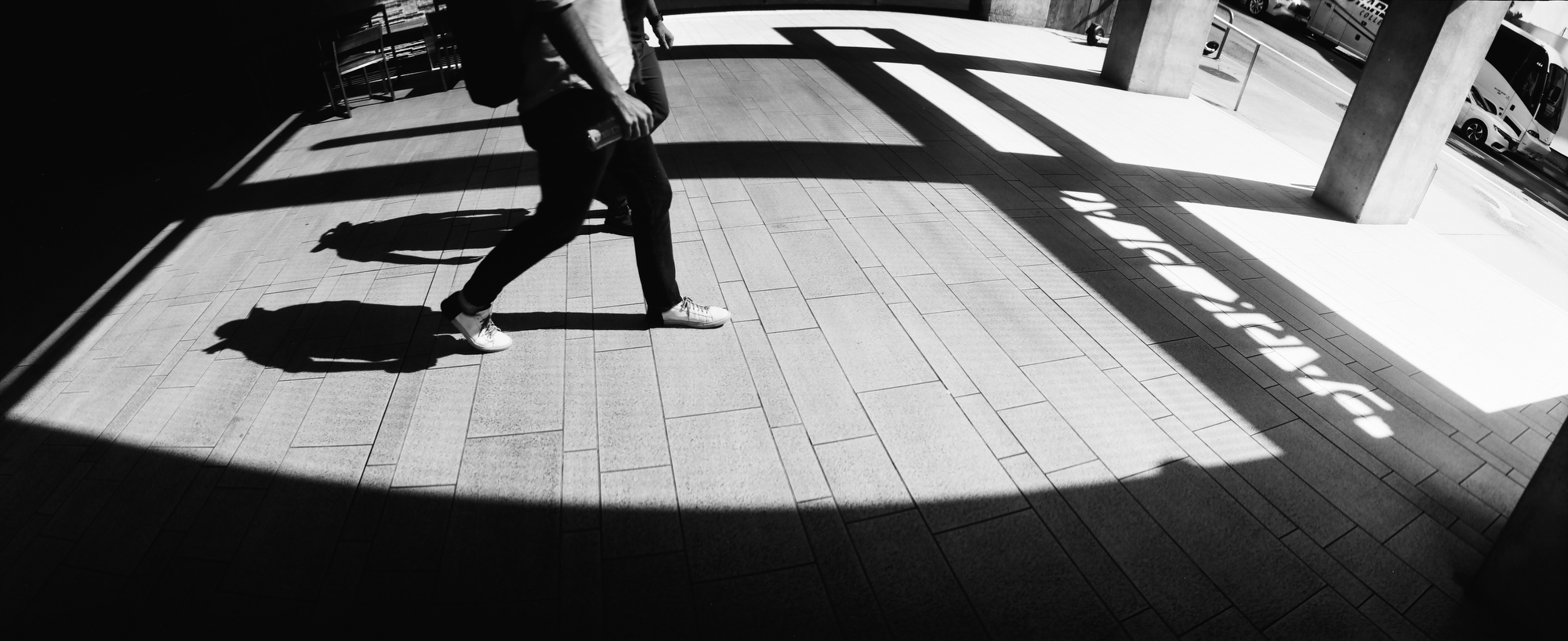
Days end below grade, crossing concrete,
Departing park place, with the last of the days light stretching across the city.
Hilltop trees and earth excavated over a century ago.
Sight lines low, avoidant of the warm light.
Our departure on repeat.
Days end below grade, crossing concrete,
Departing park place, with the last of the days light stretching across the city.
Hilltop trees and earth excavated over a century ago.
Sight lines low, avoidant of the warm light.
Our departure on repeat.

In Post Alley below Pike Place Market in Seattle, every direction presents another layer of graffiti, signs, staircases, storefronts, and people weaving through narrow passages. Add in the bright summer sky pouring into the alley while the alley below remain in deep shadow, and it becomes an exposure challenge as much as a compositional one.
I loaded my Widelux F7 with Rollei RPX 100 and embraced the challenge. Rather than exposing for the highlights or the shadows alone, I metered both and settled on an exposure somewhere in the middle, hoping the negative would preserve the atmosphere I experienced standing there.
The result is a photograph that invites your eye to wander. From the bright opening at the end of the alley through the shadowed corners beneath the market and up the stairs to the sunlight.
I wandered down to Seattle’s Pier 62 on the evening of the FIFA Fan Festival, curious less about the match itself than the atmosphere surrounding it. Thousands of supporters streamed toward the waterfront from every direction, draped in national colors, and carrying flags that danced in the evening breeze.
As I watched the crowd, a young girl stepped down from a bicycle taxi carrying a large Iranian flag. Almost instinctively, I moved into position.
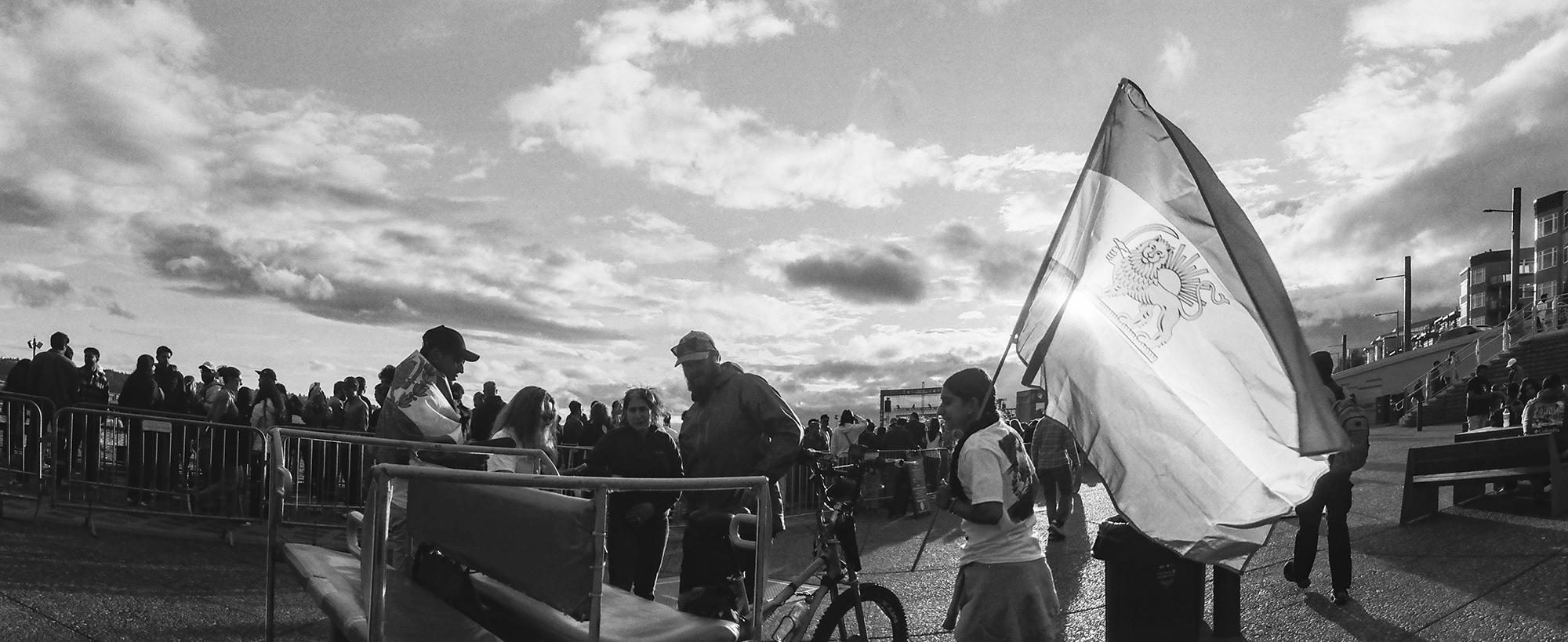
With a Widelux, moments like this happen quickly. Shooting into the sun often produces heavy lens flare, so I waited for the flag to catch the wind and drift between the lens and the sun. For a brief instant, everything came together. The flag billowed just enough to block the direct sunlight, eliminating the flare while allowing the light to illuminate the fabric from behind. I framed it in the right third of the panorama, pressed the shutter, and the moment was gone.
Photography often comes down to recognizing those fleeting opportunities when light, composition, and timing align.
What stayed with me wasn’t simply the photograph—it was the scene unfolding around it.
The FIFA Fan Festival wasn’t just a place to watch football. It became a gathering place for people from every corner of the world. Families, friends, and strangers stood together celebrating their heritage while sharing a love of the game. Different languages filled the air, flags from dozens of nations waved side by side, and for a few hours, everyone was united by the same event.
It’s one of the things I enjoy most about documentary photography. Sometimes the photograph isn’t about the subject alone; it’s about the story happening around it. A single flag becomes part of something much larger—a reminder that sport has a unique ability to bring together people of different cultures, backgrounds, and experiences.
The entire scene lasted only a few seconds, but it captures exactly what I hoped to remember from that evening: not just a football match, but a celebration of people coming together.
This image is part of an ongoing collection photographed with my Widelux panoramic film camera. To see more of my Widelux work visit my website, or browse the complete archive on Daily Photo Dose.
Rather than treating Pike Place Market as an iconic landmark, I wanted this photograph to explore it as a living public space. The Widelux F7’s swing-lens panoramic perspective creates a natural, immersive sweep across the scene, allowing architecture, pedestrians, and open space to exist in careful balance. The market entrance anchors one side of the frame while the surrounding buildings and receding street draw the eye toward the distance. Individual people become part of a larger rhythm, turning an ordinary afternoon into a study of movement, geometry, and the way cities quietly choreograph everyday life.

Photographed on Rollei RPX 100, the black-and-white film softens the distractions of color and emphasizes form, light, and texture instead. The film’s smooth tonal range preserves detail in both the deep shadows beneath the awning and the bright afternoon sky, giving the image a calm, observational quality despite the busy scene. More than documenting a famous location, the photograph reflects my ongoing fascination with how panoramic film photography transforms familiar places into layered studies of space, atmosphere, and the experience of seeing.
Originally constructed in 1890, the Hull Building is one of Seattle’s oldest surviving commercial buildings and a reminder of the city’s rapid growth during the late nineteenth century. Its brick façade, cast-iron detailing, and prominent corner location have made it a lasting architectural landmark, standing in contrast to the modern towers that now surround it in Seattle’s evolving urban landscape.

